 Sign in with Steam
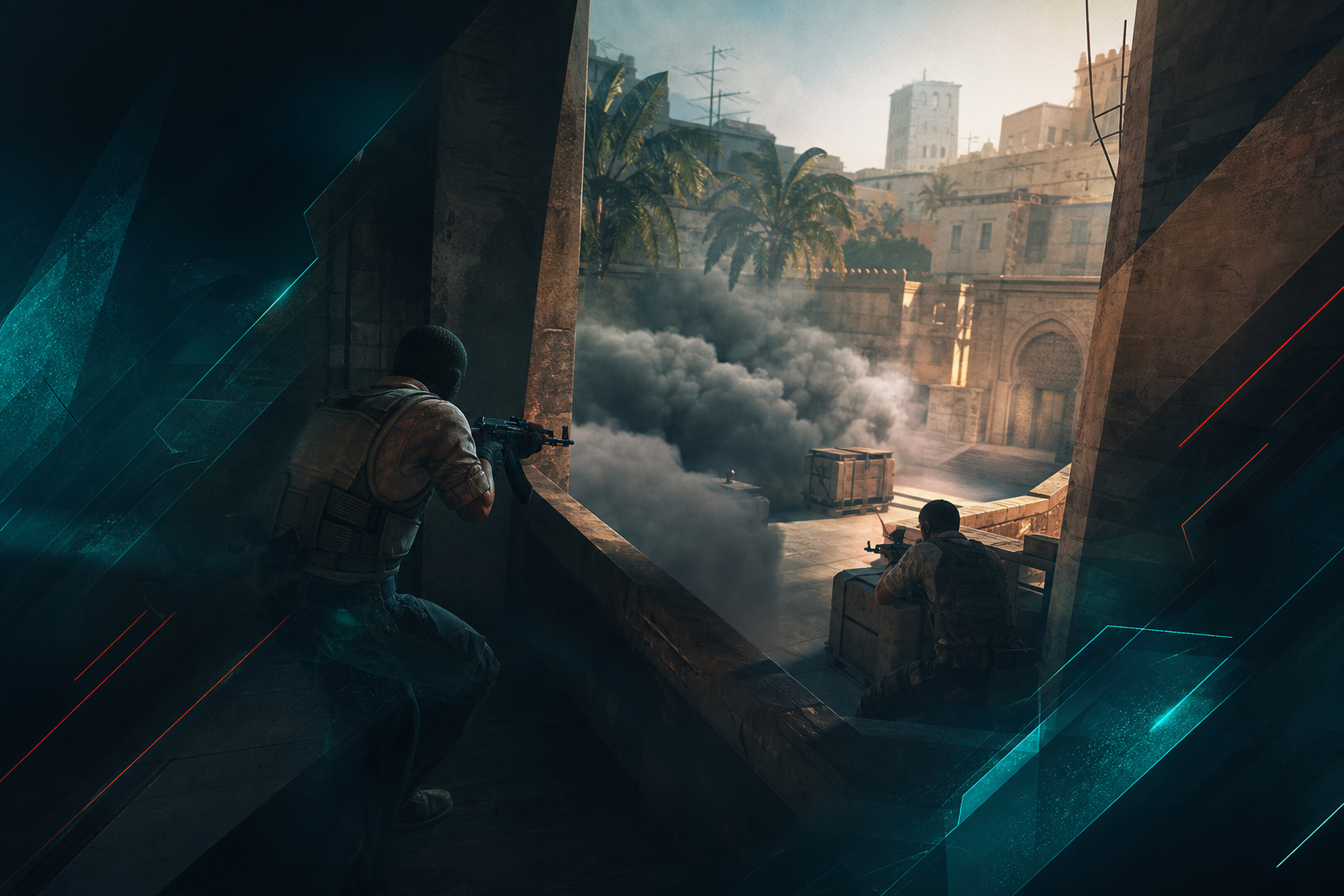
The fastest way to lose Mirage connector isn’t getting out-aimed. It’s showing too much shoulder, wide-swinging like you’re hosting a deathmatch lobby, and giving the CTs a free pre-aim. Pros don’t play connector like some heroic hallway duel — they play it like a tiny geometry problem, and they keep solving it with the same ugly little angles every single half.
That’s why connector fights are so annoying to face. One round you think you’ve cleared it, next round a rifler is tucked under the catwalk lip, a second player is jiggle-peeking from triple, and suddenly your whole A split dies because you looked at the wrong 20 pixels of the map. Mirage is built for this kind of nonsense, and good teams abuse it constantly.
Why connector is the weirdest fight on Mirage
Connector looks simple on the minimap. It’s just the link between mid, jungle, and A, right? Yeah, and Dust2 is just a desert with doors. Connector matters because it lets CTs split information and force T-side mid control into a miserable coin flip. If you lose connector early, your A hit gets pinched, your mid lurk gets cut off, and your smokes start feeling one step behind the round.
The real trick is that connector has multiple micro-angles layered on top of each other. You’re not clearing “connector.” You’re clearing the left edge of the stairs, the bench side of the opener, the underpass exit timing, the jungle peek, and the possibility that somebody’s holding a stupid off-angle with a flash ready behind him. On CS2’s subtick system, the difference between a clean swing and a dead body can be a single bad rhythm in your movement. You think you’re first. The game says no.
The small angles pros keep farming
Pros don’t need miracle aim here. They need patience, spacing, and enough disrespect to take fights one pixel at a time. Watch how teams like FaZe or Vitality approach connector control on Mirage: nobody is sprinting in blind unless they’ve already forced rotations or burned utility. The angle abuse is deliberate.
- Short edge hold. CTs hug the connector wall and expose only a sliver to mid.
- Stairs crouch. Not glamorous, but it catches the over-clear every time.
- Jungle crossfire. One player shows, the other deletes the trade.
- Under-connector punish. If T-side gets greedy, this one ends the round fast.
- Flash-and-repeek. The classic. Still disgusting. Still works.
The nasty part is how often these fights happen with rifles that cost $3,100 or less. A CT with a $2,700 FAMAS or a $2,050 MP9 can absolutely ruin a T-side AK if the angle is tight enough and the utility is timed right. That’s not theory; that’s eco math. One connector kill can swing a round where the Terrorists were already working with $2,400 buys and praying for a clean plant.
How pros actually take the space
Most players try to “clear” connector by leaning into it with a full strafe and a prayer. Pros treat it like a sequence. First, they steal the right info. Then they force the defender to move. Then they take the angle that was empty three seconds ago and shoot the guy who thought he was clever.
Look at how donk plays pressure on maps like Mirage and Ancient — the pace isn’t random, it’s violent timing. He’ll use that half-step to bait a jiggle, then burst with a perfect counter-strafe the instant the CT repositions. m0NESY does the same thing from a different angle, and the scariest part is how little room he needs to get a shot off. Connector rewards players who understand timing windows more than raw rushing. If you’re off by even 0.2 seconds, the defender gets to hold the angle for free.
That’s where subtick gets interesting. People love to argue about whether it feels “off” or “better,” but in connector the practical reality is simple: your movement timing matters more than ever. If your shoulder peek is sloppy, the defender sees you. If your counter-strafe is late, your AK spray starts moving before the crosshair does. Mirage does not forgive that stuff.
Utility that makes the angle abuse disgusting
Connector fights get nasty when utility isn’t just thrown, but layered properly. A single smoke can block vision, sure. Good teams want more than that — they want to erase the defender’s comfort, then force a bad re-peek through a bad gap. This is the kind of stuff you see at Majors when teams actually have structure and nobody’s freelancing like it’s Premier 4k rating.
On Mirage, the useful pieces are obvious, but the order matters more than the lineup clipboard nonsense people obsess over:
- Mid smoke to cut off the first contact.
- Jungle smoke if you’re splitting A.
- Window pressure so connector can’t sit still.
- Pop flash from top mid or cat for the actual swing.
A good connector take often starts with a 2-1-2 split in player positions, then compresses into a quick burst once the CTs reveal their setup. If the CT side is down to one rifle, one SMG, and a desperate half-buy, they usually can’t defend both jungle and connector cleanly. That’s when the angle abuse goes from “smart” to “mean.”
Why bad Mirage teams keep dying there
The worst part is that people know connector is dangerous and still walk into it like it’s a ladder server. They spam one smoke, dry peek the edge, and then blame “peekers’ advantage” after getting one-tapped. Nah. You lost because you gave a defender the exact fight he wanted: stationary crosshair, clean timing, and no pressure anywhere else.
Bad teams also overvalue A site presence and undervalue connector denial. You see this in Premier all the time — a stack of players hovering around palace and ramp while mid stays soft, and then the whole round collapses because a CT lurk from connector splits the retake angle. Mirage punishes passive teams hard. If you don’t make connector expensive, someone like ZywOo-level discipline from a rifler or a sniper will just keep farming your space until the scoreboard gets embarrassing.
And no, this isn’t about “being more aggressive.” Aggression without shape is just noise. The best connector pressure has a rhythm:
- force the first shoulder
- take away the re-peek
- punish the rotation
That sequence is why pro Mirage looks so clean. The camera pans, the smoke blooms, one player jiggles, another swings, and suddenly the CTs are dead in a corridor that looked tiny on the map and somehow even tinier in the server.
What you should copy the next time you queue Mirage
If you’re T-side, stop treating connector like a solo highlight spot. Use it to make the CT side choose between mid and A. If you’re CT-side, stop dry-holding the same obvious line every round. Shift 20 centimeters, change the timing, and make the Ts clear a second angle they didn’t want to check.
That tiny adjustment is the whole game here. Mirage connector isn’t won by the guy with the best crosshair placement alone — it’s won by the player who understands which pixel they can safely show and when to show it. Pros abuse those small angles every match because they know the map is built on them. You should be, too.
So next time you’re on Mirage and someone says “just hold connector,” ask yourself: which angle, exactly? Because that’s the part everybody dies to.