The Case for Playing Slow T Side on Ancient Instead of Rushing

There’s a very specific kind of Ancient round that always makes me laugh: your T side gets the first pick, three bodies explode out of mid, someone yeets a nade into Donut, and 12 seconds later you’ve got four alive, zero map control, and a retake against utility-heavy CTs who are already posted on cave and A lane. That’s not pressure. That’s donating rounds.

Ancient looks like a rush map if you only watch highlight clips, but the actual CS2 version — with subtick, cleaner first-bullet registration, and CTs that can swing off info way faster than they could in the old CS:GO days — rewards patience way more than most players admit. If you want real T-side damage, stop treating every round like a 5K entry sprint.

Why Ancient punishes lazy rushing

Ancient is a weird map in the best and worst ways. The lanes are tight, the rotations are awkward, and the choke points are brutal once defenders get a read. A rushed T side usually ends up doing one of two things: you either stack bodies into a choke with no trade spacing, or you give away map control so fast that CTs can just anchor, stack utility, and wait for your bad timing.

That’s the problem. Ancient isn’t Mirage, where you can brute-force mid and still make the round feel playable. It’s not Dust2, where long or cat pressure can still create chaos after a messy exec. On Ancient, if you rush into A main or cave with no prior mid work, you’re basically trying to win a round with a lottery ticket.

And if the other side knows what they’re doing, they’ll farm you. Good Ancient CTs love early aggression from donut, mid, or cave because rushed Ts usually don’t have the spacing to punish it. One dead entry and suddenly your 2nd guy is staring at a molotov, your lurker is too far behind to trade, and the round becomes a save call before the bomb even crosses mid.

Slow T side isn’t passive — it’s control

People hear “play slow” and picture five guys sitting around doing nothing for 40 seconds. That’s not what good Ancient looks like. Slow T side means you’re taking space with a purpose, making the CTs spend utility, and forcing them to show you where the weak spots are before you commit.

On Ancient, that usually means mid first. Not always an instant mid explode, either. Just enough presence to make the defenders respect the possibility. A smoke, a flash, maybe a boost threat, then reposition. Suddenly cave can’t keep swinging freely, donut has to worry about being pinched, and the guy on B lane is wondering if he’s about to get isolated.

That’s real round value. Not pretty, but real.

What you actually get from slowing down

  • CT utility burns out faster, especially nades for mid and cave.
  • You force rotations without showing your full setup.
  • Your lurker can matter instead of being a spectator.
  • You get better late-round bomb plants, which matters a lot when your economy is thin.
  • Rounds become easier to call off if the first read is bad.

That last one matters more than people think. If your team has 2,500-ish average CS Rating players and half the squad is trying to entry like they’re donk at Katowice, your comeback rate is going to be ugly. Slow rounds give you an exit plan. Rushes just give you a scoreboard problem.

Ancient utility gets way better when you’re not panicking

CS2 made utility feel snappier in a lot of spots, and subtick made a lot of interactions less clunky than the old days, but that doesn’t magically fix bad timing. Ancient is packed with places where a single smoke or flash changes the whole round. If you rush, most of that stuff gets thrown under stress, which usually means it’s late, off-angle, or doesn’t line up with the entry.

Play slower and utility starts doing actual work. A mid smoke can deny the CTs their favorite info peek. A donut flash can let you clear close A without losing half your HP to a shoulder peek. A cave molly can force a player deeper instead of letting him farm you from the first angle. On B, a well-timed pair of smokes can make the site feel a lot smaller for the defenders, which is exactly what you want.

There’s a reason pro teams keep coming back to structure on maps like Ancient. Watch a real Ancient round from MOUZ, FaZe, or Vitality and you’ll see a lot of fake pressure, late commitments, and lurk timing. They don’t just run at the site and pray. Even ZywOo — one of the cleanest aimers the game’s ever had — gets way more value when the round has shape to it. Same story with m0NESY when G2 are giving him space to read the defense instead of forcing him into a blind brawl.

The money side makes slow rounds even stronger

This is the part a lot of ranked players ignore. CS2 economy still punishes bad tempo. If you rush and lose two or three bodies early, you’re not just throwing that round. You’re wrecking the next one too.

Think about it in round numbers. A standard rifle buy on T side is roughly $2,500 to $4,500 depending on nades and armor. If your rush dies in 20 seconds, those AKs, armor kits, and flashes don’t get much value. A slower round that at least forces CT utility and gets a plant can turn a likely loss into a workable 2nd-round buy after the plant money kicks in. That’s how you keep your side from falling into the classic CT-sided spiral where every gun round is a desperate force buy.

And Ancient can snowball hard. A planted bomb means your loss bonus math gets less ugly, your future buys are cleaner, and suddenly you’re not running three Galils and hoping someone pops off. If you’re trying to grind Premier and your team keeps bleeding money on dead rushes, the map starts feeling unwinnable when it’s really just your tempo that’s bad.

How to actually play slow without looking lost

You don’t need a full strat book to stop rushing Ancient like headless chickens. You just need structure. A decent pug stack can do this with basic comms and a little discipline, and honestly that’s enough to beat a lot of teams up through mid-level Premier.

Start simple:

  • Take mid presence early, then reset.
  • Use one player to hold lurk timing instead of hard-grouping every round.
  • Save a flash for the mid-round swing, not the opening peek.
  • Let the bomb stay flexible until you know which site is weaker.
  • Call off hits if you burn too much utility or lose the first contact.

That’s it. No magical CS2 voodoo. Just enough patience to force the defense to react before you do. If a CT keeps jiggle peeking mid for info, punish it. If cave is getting overplayed, fake that side and go elsewhere. If your A split is getting smoked out every time, stop treating A main like a moral obligation and hit B through a later timing.

Rushing has its place. Ancient just isn’t that place

I’m not saying never rush. A few fast rounds matter because they keep CTs honest, and every good Ancient team needs a burst round in the pocket for when the defenders get greedy. But if that’s your default, you’re making the map easier for the other side.

The best Ancient T halves I’ve seen — whether it’s in Major play, high-level FACEIT, or a nasty playoff run when teams are actually prepared — usually have this same pattern: patient early rounds, one or two tempo changes, then a sharp late-round hit when the CT side finally starts guessing. That’s how you beat a map that looks simple from the outside but keeps punishing lazy habits inside the round.

If you keep sprinting into Ancient and hoping aim saves you, you’re basically betting your half on someone else whiffing. Wouldn’t you rather make the CT side guess wrong for once?
The Best Utility Pairings for B Site Hits on Ancient

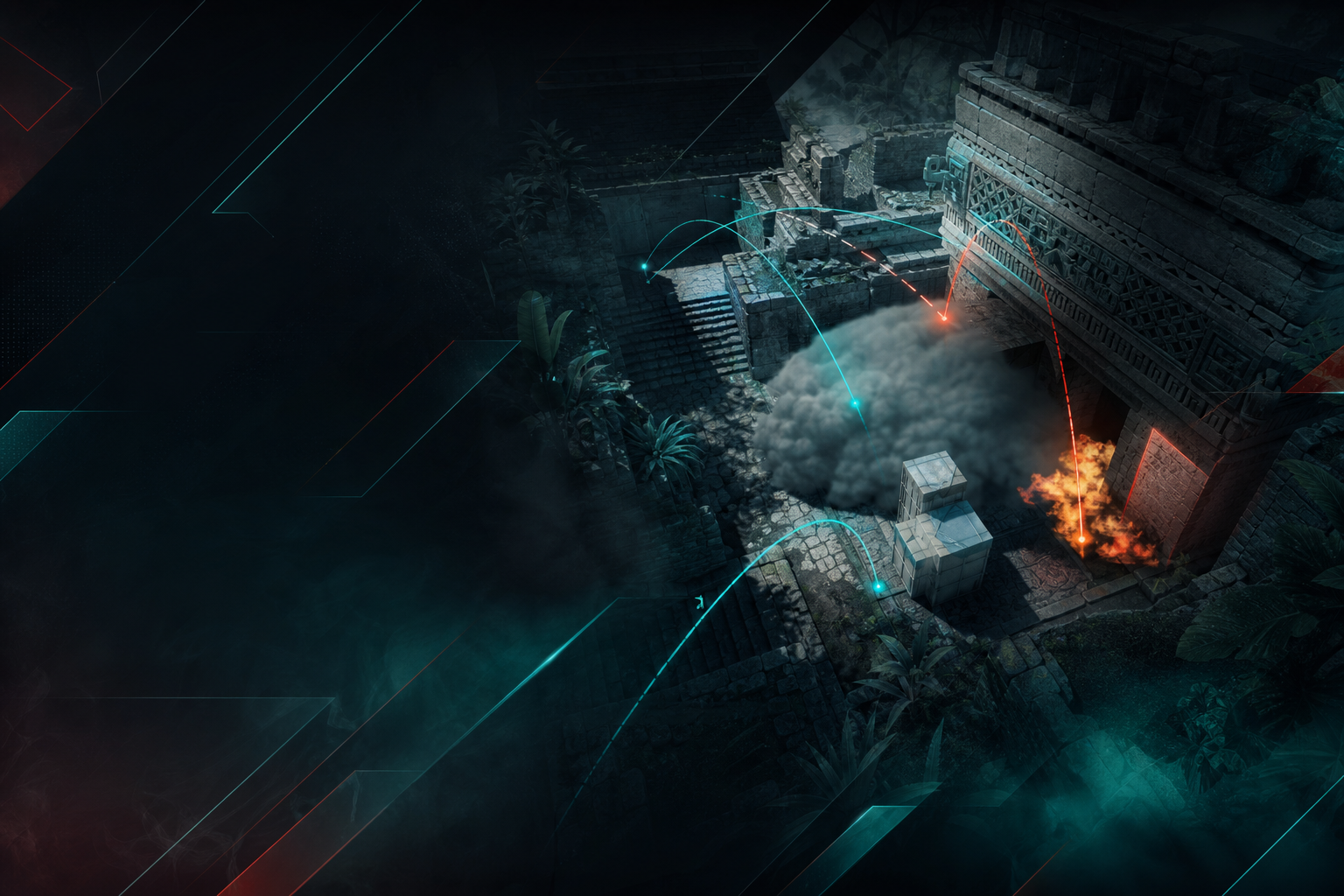
You can feel a good Ancient B hit before the util even lands. The round goes quiet for half a second, then the CT side starts burning through smoke edges, HE damage ticks up, and suddenly your five-man swing through Cave and Donut looks a lot less like a rush and a lot more like a forced eviction. That’s Ancient when it’s played right: ugly, sharp, and brutally timing-based.

The best part? B site hits on Ancient aren’t some mystery reserved for donk or m0NESY when they’re farming 14-1 in a Premier stomp. The site is actually pretty repeatable if you pair the right pieces together. You don’t need six smokes and a prayer. You need utility that covers Cave, CT, and lane pressure while letting your first contact play off the chaos.

Why Ancient B is still a pain in the neck

B on Ancient is one of those sites that punishes lazy utility harder than most maps in the pool. The CT setup can lean on a defender in Cave, one in lane/Donut, and a rotator swinging from mid or CT side through timing. If your smokes are late by even a second, the whole hit starts feeling cramped. Source 2 subtick didn’t magically erase that either — the utility still needs real timing, because the exec is only as good as the moment your flashes pop and your first rifler swings.

The map’s geometry does half the work for the CTs. Cave is a nightmare if you leave it half-open. Donut can pinch from an angle that feels unfair until you’ve smoked it a hundred times. And if your team doesn’t split attention between main B and mid pressure, the defenders get to cheat rotations way too early.

The utility pairings that actually make B hits work

Good Ancient B hits are built around pairing pieces that solve two problems at once. One smoke should block a sightline and buy space. One flash should blind a known swing and also cover the entry path. One molotov should force the defender off the strongest anchor spot, not just make a pretty fire puddle.

Smoke + flash: the bread and butter

This is the cleanest pairing on the map. Throwing a smoke for Cave or CT is nice, sure, but it becomes nasty when the flash is timed to catch the defender peeking through the edges or trying to re-swing after the smoke blooms. A lot of Ancient B hits fall apart because teams smoke and then wait like they’re asking permission. Don’t do that. Pop the flash as the smoke lands, and force the anchor to guess.

My favorite version is the simple Cave smoke plus a high flash from main B. It gives your first two players room to take site space without getting shredded by the close angle. If the CT has a molotov for your push, this pairing still works because the flash denies the re-peek after the fire fades.

Molotov + flash: punish the anchor, then punish him again

This pairing is nastier than it gets credit for. A molotov on Cave or default B site doesn’t just clear space — it tells the CT player exactly where not to stand. Then the flash forces him to move while he’s already boxed in. That’s the whole trick. You’re not trying to kill him with utility; you’re making him choose the wrong position before the duel even starts.

If your team has a player with good timing, let him swing off the flash the second the molotov starts doing real damage. On a lot of Ancient rounds, that’s the difference between taking site cleanly and getting stalled for 12 seconds while the CTs stack rotations through Donut.

Double smoke setups are better than they sound

People love to talk like Ancient is a one-smoke map. It isn’t. The best B hits usually use at least two pieces of smoke coverage: one for Cave, one for CT or Donut depending on your pathing. The reason this works is simple — one smoke cuts off vision, the other cuts off punishment. Leave either lane open and the CTs can spam, swing, or fall back with info.

  • Cave smoke to block the anchor’s first fight.
  • CT smoke to stop the rotator from taking the clean retake angle.
  • Donut smoke if you’re hitting through mid and want to kill the pinch.
  • Flash over roofline to force any close contact off the angle.

That last one matters more than people admit. Ancient flashes that go too low are basically free assists for the CT side because they can look away, hug cover, and wait for the pop to fade. A real high flash over B main or mid entrance is what makes the smoke pair matter.

The cleanest B execs depend on where you’re coming from

Not every B hit on Ancient should look the same. If you’re coming from main, your utility is about breaking the front line. If you’re splitting from mid, you’re trying to stretch the defense until the site feels underdefended. That’s a different problem, and bad teams mix those up all the time.

Main B hits: fast, loud, mean

When you’re running straight main B, the strongest pairings are Cave smoke plus pop flash, then a molotov for default or the back of site. That lets your first guy challenge the space while the second player clears close right and ruins any CT who’s hiding to trade. This is the kind of round where timing is everything. A half-second gap and the defender gets a free multi-kill. Tight timing and the anchor has to either fall back or die.

On a 64-tick server — which is what you’re usually dealing with in Premier anyway — people still underestimate how clean a basic smoke-flash combo can be when it’s thrown with purpose. Source 2 subtick helped with feel, but it didn’t suddenly make sloppy team play good. You still need people lined up and ready to move.

Mid-to-B splits: annoying in the best way

These are my favorite Ancient hits because they make CTs miserable. If one player or pair threatens Donut while the rest of the team pressures B main, the CTs have to split their util. That’s when the pairing changes: a Donut smoke plus a B main flash, or a B main smoke paired with a late molotov for lane. The goal is to deny the crossfire, not just enter the site.

This is also the kind of structure that shows up when pro teams are really in control of the map. You’ll see squads at majors — especially when teams like FaZe or Vitality are dictating pace — use the threat of a split to force a bad defender decision before the actual hit even starts. It’s not flashy, but it wins rounds. Same reason teams with players like ZywOo or donk look so brutal on Ancient: they’re not just taking aim fights, they’re taking the right fights after the defense has already been bent out of shape.

The pairings I trust most, round after round

If I had to trim Ancient B utility down to the stuff I’d actually want in a scrim or a Premier grind, it’d be these pairings:

  • Cave smoke + high flash — best default hit starter.
  • CT smoke + site molly — clean for stopping the retake timing.
  • Donut smoke + B main flash — great for splits, annoying for CT comms.
  • Cave molly + pop flash — brutal on anchors who like to play close and greedy.

Two small things matter here more than people want to admit. First, don’t stack all your utility at the choke point and then dry peek anyway. That’s Bronze-level CS dressed up as strategy. Second, call the timing clearly. If your flash pops early and your entry is still tucked behind the smoke, the defense gets a free reset and your whole exec turns into an expensive noise complaint.

What good Ancient teams do that average ones don’t

The good teams don’t just throw utility. They chain it. One piece creates movement, the next punishes the movement, and the third stops the CTs from re-taking the space they just lost. That’s why Ancient B hits feel oppressive when they’re done well — it’s not raw volume, it’s the order.

When I watch the best teams play this map, I’m always looking at the same thing: are they using util to force a decision, or just to make the minimap look busy? Big difference. A team that’s actually in sync will pair smoke and flash to isolate Cave, then use a molotov to cut off the only good recover angle. A messy team throws three grenades and still has to win a fair gunfight. That’s how you lose rounds you should’ve owned for free at 5,500 cash in a comfortable buy.

Ancient B doesn’t need fancy theory. It needs pairings that do two jobs at once and a team that isn’t allergic to timing. If your utility isn’t buying space, killing pressure, or forcing a terrible retake, what exactly is it doing?

How donk Breaks Ancient Mid with Pure Timing and Positioning

donk doesn’t take Ancient mid like most riflers do. He doesn’t slowly “clear space” with a default and wait for the round to tell him what’s next. He just appears in the right lane at the right time, and half the lobby is suddenly reacting instead of planning. That’s the whole thing. On a map where mid control decides whether you can pressure B, split A, or just suffocate the CT rotator, his timing makes Ancient feel unfair.

And yeah, the stats back up the eye test. When teams let him get early initiative on Ancient, the mid fight gets ugly fast because he’s not winning with some magical one-tap cosplay — he’s winning with spacing, contact timing, and the fact that he understands exactly when a CT shoulder should be there and when it usually isn’t. That’s pure CS2 brain, not highlight merchant nonsense.

Why Ancient mid is such a nasty place to play from

Ancient mid is weird in the best and worst ways. It’s narrow enough that utility matters, but open enough that raw aim still gets to bully people. You’ve got donut pressure, top mid control, cave lurking, connector fights, and fast CT rotations through CT spawn if the defenders read the round early. If you lose that space, your whole T half starts looking like a half-baked exec with no teeth.

That’s why donk is such a pain. He doesn’t just peek mid; he times the peek around the CT’s rotation habit. On Ancient, a lot of players default to a rhythm: molly top mid, shoulder, fall back, re-peek off flash, maybe tuck by the box. donk hates that rhythm. He’s constantly looking for the micro-window between utility landing and the defender’s next move.

Source 2 made that kind of timing even sharper. Subtick means your click is being read with more precision than the old “I swear I shot first” era, and someone like donk thrives when the server’s resolving his swing exactly as he wants it. He’s not gambling on janky peeker’s advantage. He’s forcing a duel where the CT is already half a beat late.

The real trick: he’s not fast, he’s early

This is where people get it wrong. They see donk flying into mid and call it pure speed. Nah. Speed helps, obviously, but the sauce is that he’s early to the decision point. He knows when the CT anchor on Ancient is likely to be changing positions, when the rifle behind the smoke is nervous, and when the guy under pressure from A ramp is about to look the wrong way.

That’s why his mid presence often looks dumb in real time and genius on replay. On the live round, it just seems like he wide-swung into three players and won. On the replay, you notice the molly faded, the flash came out one second too late, and the CT in donut had just shifted to support B. That one second is everything. Ancient mid is basically a stopwatch test disguised as a gunfight.

You see the same principle from other monsters, too. m0NESY does it with AWP angles on Mirage. ZywOo does it when he reads the rotate on Inferno and punishes the gap before the smoke bloom settles. donk just applies that same reading to rifle space on Ancient, which is meaner because the target has less room to survive the mistake.

Positioning: he stands where your crosshair doesn’t want him

donk’s positioning on Ancient mid is annoying because it’s never the obvious lane. He loves weird offsets, half-cover fights, and those cheeky stances where he can see enough of the area without committing to the whole map. He’s not always front-midding for a duel. Sometimes he’s one step back, forcing CTs to overclear, then he swings when they’ve already spent their attention.

That’s huge on Ancient because the map punishes lazy clearing. If you’re defending mid and you don’t isolate donut, top mid, and connector in the right order, you get sliced up. donk makes you guess wrong. He’ll sit in a spot that looks clear, let your utility land, and then take the space after your gun barrel is already pointed elsewhere.

And when he does take contact, it’s rarely a straight coin flip. He’s usually got one of these advantages:

  • He’s closer than you expected.
  • He’s not in the center of the angle.
  • He’s moving during your first shot.
  • He’s baited your flash or molly timing.
  • He’s already heard you commit from cave or T mid.

That’s what makes him feel impossible to trade. By the time a second CT rotates in, the duel has already been decided. He’s not just beating the first guy — he’s deleting the whole response.

Utility doesn’t stop him; it just changes the timing math

People overrate utility against a player like donk when they’re talking about Ancient mid. Smoke mid? Fine. Molly top mid? Great. Pop flash from donut? Sure. If the timing is wrong, none of it matters. A bad smoke is just a temporary wall, and donk is extremely good at standing outside the wall until the defender gets bored and peeks anyway.

That’s the ugly truth of CS2’s current meta. Teams love to pretend utility is the answer to everything, but if your mid setup is passive and slow, you’re just giving elite riflers room to work around your structure. Ancient especially rewards the team that owns the first 15 seconds. If you don’t, donk will happily turn your “safe default” into a 4v5 before the round really starts.

He also understands when to stop. That matters more than people think. A lot of aggressive players overstay, especially in high-pressure Premier games where everyone wants to farm CS Rating. donk will take the kill, shift the map, and vanish before the trade swing arrives. That discipline is why his aggression doesn’t look reckless, even when it feels like a crime scene.

What he’s actually reading in the round

When donk works Ancient mid, he’s reading a stack of tiny things all at once:

  • the first smoke timing
  • whether the CT is fighting for top mid or falling cave
  • if the flash came from donut or CT
  • how long the rotation from B is taking
  • whether the A player is overhelping connector

That’s a lot of information for one guy to process, but that’s why he’s different. He’s not reacting to one cue. He’s reacting to the pattern. And once he sees the pattern, the rest of the round feels solved.

Why Ancient mid makes donk look even scarier than Mirage

Mirage is still the king of mid-control clips, no question. Everyone knows the connector timing, the window punish, the cat swing. Ancient is uglier, though, and that’s why donk stands out there. On Mirage, a lot of riflers can look sick if they get the right spawn and a decent flash. On Ancient, the map is less forgiving. The spacing is tighter, the geometry is messier, and your movement needs to be cleaner because one bad step can throw the whole fight.

That’s why I’d argue donk’s Ancient mid work is more impressive than a lot of the flashy Mirage stuff people clip for Twitter. Ancient asks for patience and violence at the same time. You need to wait without becoming passive. You need to explode without losing your spacing. Most players pick one. donk somehow gets both.

It also fits the current CS2 meta better than people admit. Since the game leans so hard on timing, reaction, and subtick precision, the players who understand contact pressure are eating. donk is one of them. s1mple did it with impossible AWP reads for years, and donk’s doing a rifle version of the same thing — just without the luxury of a scope and with way more bodies trying to body-block him.

What everyone else should steal from him

You’re not donk. Nobody is. But if you want to stop getting farmed in Ancient mid, steal the parts that matter and stop copying the part where you dry-swing three rifles and call it confidence.

  • Watch the clock, not just the radar.
  • Take space after utility, not through it.
  • Peek from odd positions so your angle is ugly to clear.
  • Don’t overstay after the first frag.
  • Force CTs to rotate before they’re ready.

If you’re playing Ancient in Premier and your team keeps losing mid, it’s usually not because your aim is garbage. It’s because your timing is predictable and your positioning is honest. Honest positioning gets you killed. donk’s whole game on Ancient mid is built on being one step ahead of what the CT thinks is “normal.” That’s the part everyone misses when they call him a pure aimer.

So the next time you watch him shred Ancient mid, don’t just look at the killfeed. Watch where he stands, when he moves, and how often he hits the exact moment the defender is least ready. That’s the real weapon. Not speed. Not luck. Timing so sharp it makes everyone else look asleep.